 Nemorgi
Shopping
Black Friday deals: how to spot a fake discount
Most Black Friday "deals" were the same price or cheaper at other times. Here's how to check a discount in two minutes in the US and UK before you pay.
Short answer: a Black Friday deal is only real if the price is lower than what the item has actually sold for in the last few months. The "was" price on the sticker doesn't tell you that. Check the item's price history (or note the price yourself a couple of weeks before), compare the total cost with delivery, and don't let a countdown timer rush you.
Black Friday is on Friday 27 November this year, and the sales around it now run for weeks. That's good news if you know what you want and what it normally costs. It's bad news if you're relying on the "was £249, now £179" label to tell you whether that's a good price.
What the numbers say
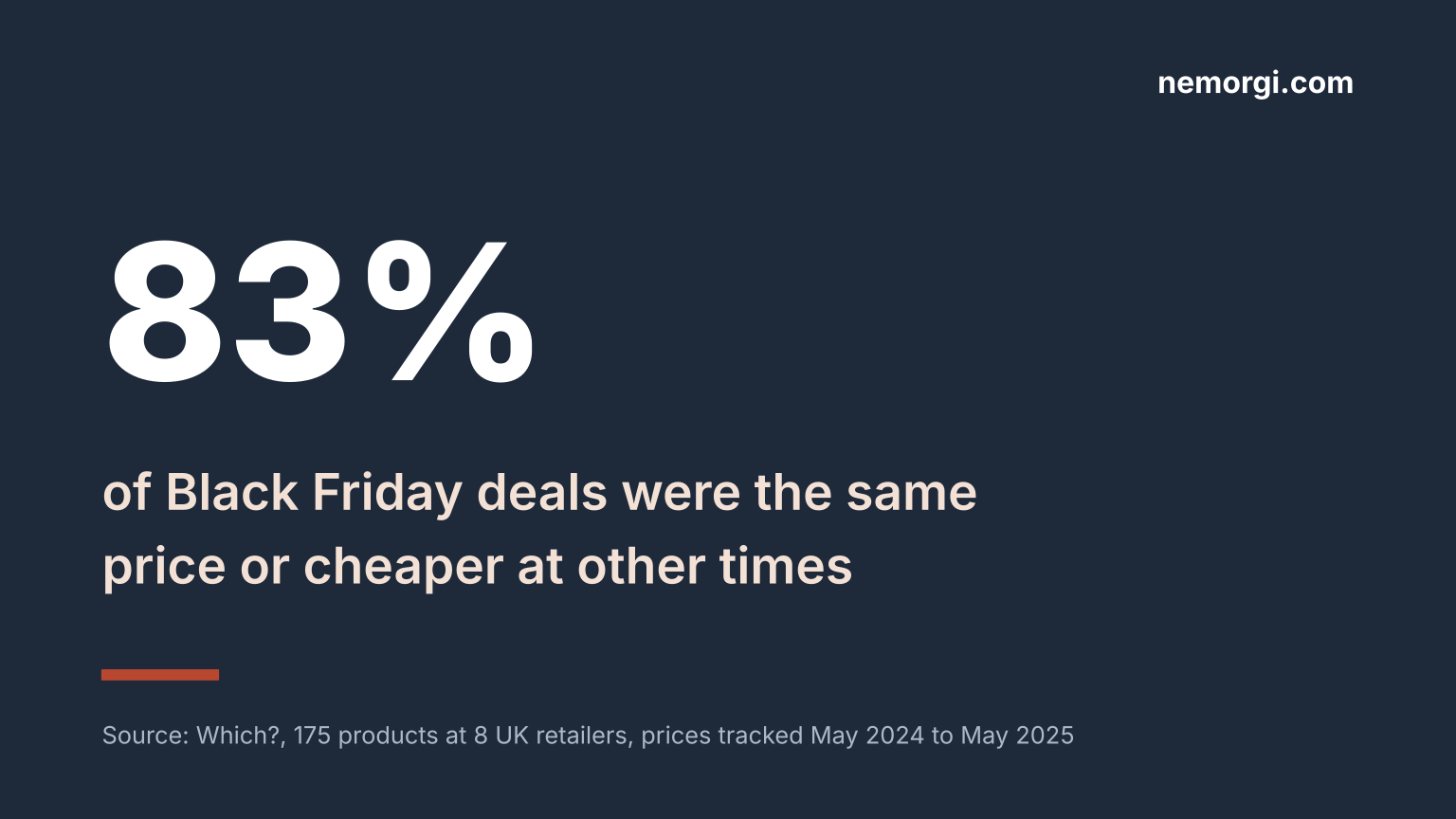
UK consumer group Which? tracks Black Friday prices every year. For the 2024 sales, it followed 175 home, tech and health products at eight big retailers for six months before and six months after the sales period. 83% of them were the same price or cheaper on at least one occasion outside the sale (Which?, 25 Nov 2025).
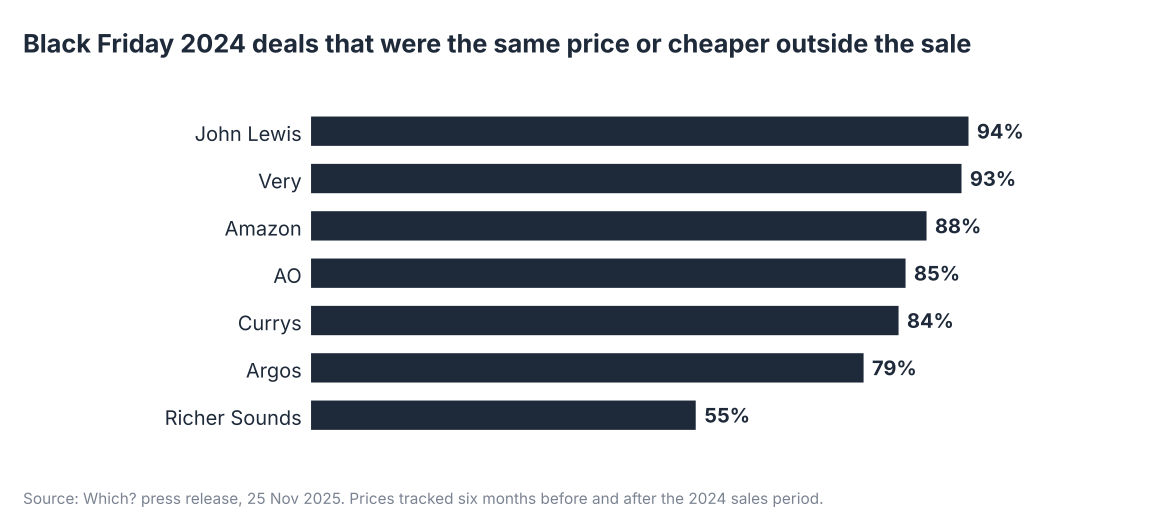
The pattern isn't new. In Which?'s 2023 analysis of 227 deals, 92% were the same price or cheaper at other times of the year (Which?). Some products are genuinely cheaper in late November. Many simply aren't.
What the law says about "was" prices
In the US
The Federal Trade Commission's Guides Against Deceptive Pricing say a former price used in a comparison must be "the actual, bona fide price at which the article was offered to the public on a regular basis for a reasonably substantial period of time" (16 CFR § 233.1). Inventing an inflated "regular price" just to advertise a bigger discount is exactly what the guides warn against. Several states, including California, have their own rules on former-price advertising too.
In the UK
Since 6 April 2025, the Digital Markets, Competition and Consumers Act 2024 lets the Competition and Markets Authority decide for itself whether a business has broken consumer law and fine it up to 10% of its global turnover, without going to court first (GOV.UK). Misleading price comparisons and "drip pricing" (adding unavoidable fees late in checkout) are both in its sights.
The law helps after the fact. Checking before you buy is quicker.
A two-minute check before you buy
- Get the exact model number. "Sony WH-1000XM5", not "Sony headphones". Retailers sometimes sell slightly different model codes so prices can't be compared directly.
- Look at the price history. Price-tracking tools such as PriceRunner (UK) or camelcamelcamel (Amazon) show what the item has cost over the past months. Which? recommends the same thing. If it was cheaper in September, it's not a deal.
- Compare the total, not the headline. Add delivery, installation, removal of your old appliance and any "protection plan" the checkout tries to add.
- Check who's selling. On marketplaces, the third-party seller, not the platform, usually handles returns and warranty claims.
- Search two other retailers. If everyone has the same "Black Friday price", it's probably just the market price.
The trick that works: write down the price of the three or four things you actually want today. On Friday you'll know in seconds whether the "deal" is any good.
Red flags
- A huge, round discount (–50%, –60%) on something that is rarely discounted.
- A "was" price you can't find anywhere in the item's history.
- A countdown timer that resets when you reload the page.
- A model number that only exists at one retailer.
- "Only 2 left!" on an item that has been in stock for weeks.
If you've already bought it
UK: for most things bought online, you have 14 days from delivery to cancel for any reason under the Consumer Contracts Regulations, then 14 days to send the item back (Citizens Advice). Changed your mind about a "deal"? Send it back.
US: there's no general federal right to return something just because you changed your mind. You're relying on the retailer's own return policy, which many extend over the holidays. Check it before you buy and keep the receipt.
In both countries, if a price comparison looks fake, you can report it: the FTC at ReportFraud.ftc.gov in the US, and via Citizens Advice, which passes reports to Trading Standards, in the UK.
FAQ
Is it illegal to raise prices before Black Friday?
No. Shops can change prices whenever they like. What they can't do is advertise a fake saving based on a "was" price that wasn't genuinely charged.
Are Cyber Monday deals better?
Sometimes, for some categories. The same check applies: compare against the price history, not the sticker.
What if the price drops after I buy?
Some retailers offer a price-match or price-adjustment window; ask. Otherwise, if you're still within the return window, you can return it and buy it again at the lower price.
Sources
- Which?: most Black Friday deals the same price or cheaper at other times of the year (25 Nov 2025)
- Which?: Black Friday deals exposed as duds (2023 analysis)
- FTC Guides Against Deceptive Pricing, 16 CFR Part 233 (eCFR)
- GOV.UK: CMA's new consumer protection regime comes into force
General information, not financial or legal advice. For your specific situation, talk to a consumer adviser or a professional.
No sign-up · runs in your browser